






















Top 40 under 40 Trial Lawyers award
Orlando Men and Women 2025 Of the Year Award
10.0 Avvo Superb Lawyer Rating
Orlando Top Lawyers 2012 - 2025
Best Lawyers in America Award
Florida Legal Elite Award
Best Lawyers 2026 Award
Orlando Sentinel Best Bets Lawyer Award

A TK LAW GUIDE ON DOMESTIC VIOLENCE · FLORIDA FAMILY LAW

Domestic Violence in Florida

What Are the Warning Signs of Domestic Violence and Abuse?  What Should You Do If You Are Experiencing Domestic Violence?

If you are in danger right now Call 911.

If you share a device or an account with the person you are afraid of, consider using a device they cannot access.

You're not alone.

Domestic Violence can Impact Every Case

In Florida, domestic violence, and domestic violence allegations, are taken very seriously by both the Florida criminal and the civil courts. Family and domestic violence, including child abuse, intimate partner abuse, and elder abuse, is a common problem in the United States. Family and domestic violence are estimated to affect 10 million people in the United States every year. It has even been categorized as a national public health problem.

Most people who walk into a family law office are not there to talk about abuse. They are there about a divorce, a paternity case, a relocation, a modification, a probate dispute among siblings. Domestic violence almost never arrives labeled as domestic violence. After thousands of consultations, most of the time, domestic violence appears in the background and it can usually be identified by the patterns of violence. 

A client who is never asked about domestic violence will often not volunteer information. Statistically, a client who leaves the marriage in the exact window when risk of serious violence is highest, with no safety plan and no injunction on file.

Unfortunately, some people use allegations of domestic violence as a way to gain leverage in litigation. It is important for lawyers, judges and the general public to get a better understanding of what domestic violence is and what it is not. We are lucky in the State of Florida that the judges and the court system take these cases seriously and there has been a strong emphasis on education.

What is Domestic Violence in Florida?

Florida defines the term “Domestic Violence” narrowly, and that surprises people. Under section 741.28(2), Florida Statutes, “domestic violence” means an assault, aggravated assault, battery, aggravated battery, sexual assault, sexual battery, stalking, aggravated stalking, kidnapping, false imprisonment, or any other criminal offense resulting in physical injury or death of one family or household member by another.

The relationship element is equally specific. Section 741.28(3) defines “family or household member” as spouses, former spouses, persons related by blood or marriage, persons who live together now or have lived together in the past as if a family, and people who share a child. With the sole exception of co-parents, the parties must live together now or have lived together in the same single dwelling unit at some point.

Notice what is missing from Florida’s Domestic  Violence definition: Financial control, surveillance, isolation from family, threats that stop short of a criminal assault, and the steady grinding erosion of a person’s independence are not, standing alone, “domestic violence” under the statute. While these may be indicators of control they alone do not violate Florida law or give rise to the imposition of injunction for protection from domestic violence. Researchers categorize these behaviors and patterns generally as coercive control, and it is now the dominant framework for understanding intimate partner abuse. 

Table of Contents

Domestic Violence Patterns in Florida

Family courts and the researchers who advise them distinguish between different patterns of violence, because the pattern, not necessarily the single incident, predicts what may happen.
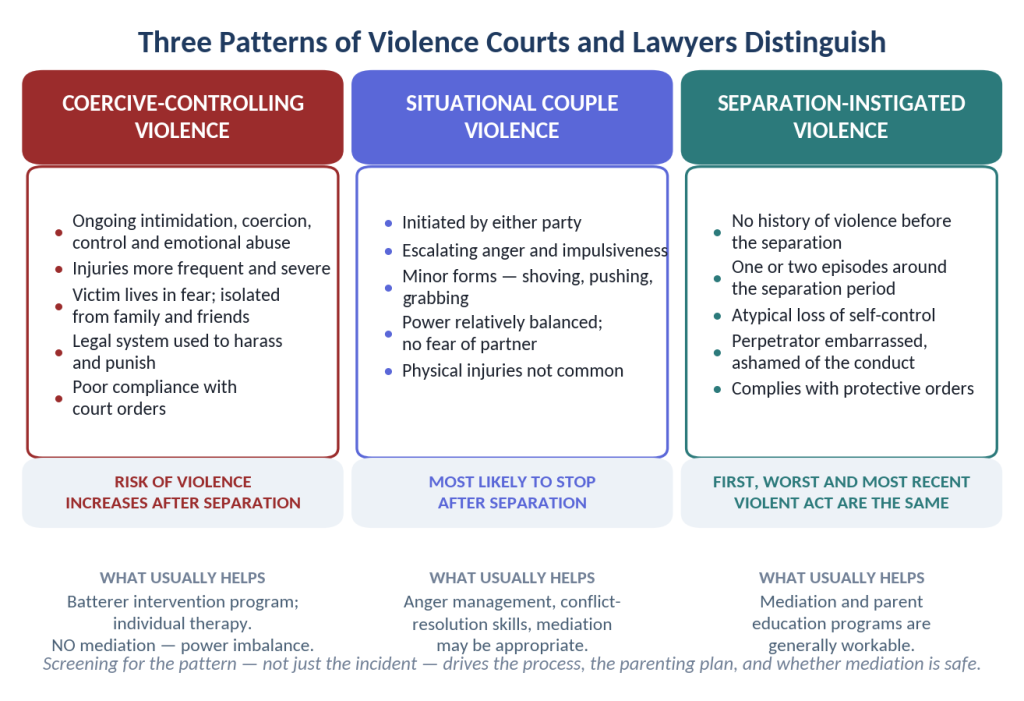
Coercive Chart illustrating three patterns of violence

Figure 1. Coercive-controlling violence, situational couple violence, and separation-instigated violence produce very different cases and call for very different interventions.

Interestingly, Florida’s Domestic Violence Benchbook instructs judges not to refer a case to mediation where there is a significant history of domestic violence that would compromise the process, or create a power imbalance, and it advised judges against substituting an anger management program for a certified batterers’ intervention program.

More about Coercive Control

Coercive control leaves no bruise. There is usually nothing visible that your family, friends, or even your lawyer can see. Coercive control is defined as a sustained pattern of domination usually including one or more of the following: monitoring, isolation, financial restriction, intimidation, humiliation, and threats that gradually removes a person’s freedom to work, spend, drive, speak to family, seek medical care, parent independently, or leave. Frequently, the victim reorganizes their life around avoiding the other person’s reaction.

A few things that I look out for when I meet with someone are: tracking a phone, a car, or a bank card; threatening to take the children, to report someone to immigration, to ruin a career, or to make sure no judge believes them; financial control and cutting off access to money, then blaming the household’s condition on the person who has none; using school enrollment, medical consent, therapy decisions, and parenting exchanges as leverage; or flooding a phone with hundreds of messages, or a docket with repetitive filings, until the other side simply cannot keep going.

For years these coercive control patterns failed to get the court or the legislature’s attention. Because Florida law defines domestic violence as a list of crimes, and none of them described a decade of surveillance and financial captivity, courts would routinely deny relief to victims of coercive control.

In 2023, the law changed with Greyson’s Law, which enacted which amended two statutes at once. Section 741.30(6)(b) of Florida Statutes now directs the court, when deciding whether a petitioner reasonably believes she or her child is in imminent danger, to consider whether the respondent has engaged in a pattern of abusive, threatening, intimidating, or controlling behavior — a series of acts over a period of time, however short, that shows a continuity of purpose. Coercive control is no longer just a clinical term. In the right case it is a statutory factor.

Greyson’s Law made a parallel change to Section 61.13, Florida Statutes. In deciding whether shared parental responsibility would be detrimental to a child, the court must now consider evidence of domestic violence rather than only a conviction, and must consider whether either parent has or has had reasonable cause to believe that the parent or the child is or has been in imminent danger of domestic violence, sexual violence, abuse, abandonment, or neglect by the other parent. It no longer matters whether or not any case was ever filed. That means threats directed at a parent can be connected to the child’s safety.

This also supplies the answer to a question clients ask constantly. Florida law now presumes that equal time-sharing is in a child’s best interests, and that presumption can be rebutted by the greater weight of the evidence. Coercive control evidence is one of the primary ways equal timesharing or “50/50 custody” gets rebutted. 

While it is true that nothing in Greyson’s Law creates a standalone claim due to coercive control, evidence of these pattens can help establish reasonable fear which is the basis for an injunction, or detriment for parental responsibility, or need under section 61.08 by explaining why a spouse has no income history, dissipation or unequal distribution under section 61.075 where the control was financial, and entitlement to temporary fees and suit money where one party holds every account and every record.

A word of caution, these claims can run in both directions. Overstating a coercive-control claim, or domestic violence allegations can ruin your credibility with the court and result in a finding by the court that you are the person causing the issues. I tell clients that not every high-conflict parent is abusive, and not ever jerk is going to lose custody or timesharing with their children.

In coercive-controlling relationships, the abuse also tends to move in a cycle. Understanding it explains the question survivors are asked most often and resent most deeply — why did you stay?

Free Case Review

All free case evaluations are reviewed by our legal team. For immediate assistance, please call us at 407-834-4847.

Divorce & Family Law INfo

In danger right nowCall 911 Florida DV hotline · 24/71-800-500-1119 National DV hotline1-800-799-7233

Nothing here is saved, stored, or sent anywhere.

Understanding what is happening

Two very different patterns,
one urgent question.

Domestic violence in a Florida family case usually follows one of two shapes. One is a cycle that has run through the whole relationship. The other is situational — it appears only as the marriage comes apart. Telling them apart changes how a case is handled. It does not change the first step: if you are being hurt or threatened, emergency relief is available for either one.

One

The cycle of domestic violence

Violence in this pattern is rarely constant. It moves through three stages, over and over. Three forces at the center — love, hope, and fear — keep the wheel turning and make the relationship very hard to leave.

Select any part of the wheel

The wheel

Choose a stage or a center force

The three outer bands are the stages of the cycle. The three inner wedges are the reasons people stay while it repeats. Select any one to read what it looks like in real life — and what it means for a family law case.

    Two

    Situational domestic violence

    Ending a marriage moves each spouse through a run of emotional stages — and almost never at the same speed. When one person is years ahead of the other, the gap itself becomes the danger. Something has changed, neither spouse fully understands it, and neither seems able to control it.

    Select where each spouse is

    Where you are

    Where your spouse is

    Set both spouses to see the gap

    The stages run in order: denial, shock, anger, sadness, adult adolescence, moving forward, acceptance. Two people rarely occupy the same one at the same moment.

    Three

    The difference that matters

    The distinction is one of timing, and it shapes everything from parenting plans to whether a case can be handled collaboratively.

    The cycle

    Runs through the entire marriage. It is a pattern of power and control that existed long before anyone filed anything, and separation often makes it more dangerous rather than less.

    Present the whole way through

    Situational violence

    Appears only during the breakdown of the marriage. It grows out of a clash of emotional stages rather than a sustained campaign of control, and it typically eases once the separation is resolved.

    Present only at the end
    Four

    Danger signs during a separation

    These show up in either pattern, in either spouse, and they tend to appear in clusters. Note the ones that fit your situation — nothing here is saved or sent anywhere.

    Recognizing a sign is not a diagnosis. It is information your attorney needs, because it changes how quickly a case should move and whether a courtroom, a mediator, or a collaborative team is the right room for it.
    If you are having thoughts of suicide, or thoughts of harming someone else, please reach out now — call or text 988 for the Suicide & Crisis Lifeline, any time, day or night.

    Where this fits in your case

    Whether the pattern is a cycle or situational, Florida courts can act immediately — an injunction for protection can be entered the same day, and it can address contact, the home, temporary time-sharing, and firearms. Which pattern you are living in shapes the strategy that follows.

    Talk with our family law team

    This page is general legal information for Florida residents, not legal advice, and reading it does not create an attorney-client relationship. The cycle of violence and situational violence are descriptive frameworks used by courts, evaluators, and family lawyers — they are not clinical diagnoses, and you do not have to categorize what is happening to you in order to ask a court for protection. Adapted from Form 3:160, Cycle of Violence and Situational Domestic Violence.

    '; } document.getElementById('tkPrint').addEventListener('click', function(){ var w = window.open('', '_blank'); if (!w){ alert('Your browser blocked the print window. Allow pop-ups for this page, then try again.'); return; } w.document.open(); w.document.write(worksheetHTML()); w.document.close(); w.focus(); setTimeout(function(){ try { w.print(); } catch(e){} }, 350); }); document.getElementById('tkClear').addEventListener('click', function(){ Array.prototype.forEach.call(signsHost.children, function(c){ c.classList.remove('on'); c.setAttribute('aria-pressed','false'); c.querySelector('.tick').textContent = '+'; }); count = 0; note.textContent = 'Recognizing a sign is not a diagnosis. It is information your attorney needs, because it changes how quickly a case should move and whether a courtroom, a mediator, or a collaborative team is the right room for it.'; picked.a = null; picked.b = null; lastGap = null; ['tkTrackA','tkTrackB'].forEach(function(id){ Array.prototype.forEach.call(document.getElementById(id).children, function(c){ c.classList.remove('sel','gap'); c.setAttribute('aria-pressed','false'); }); }); readout.innerHTML = '

    Set both spouses to see the gap

    ' + '

    The stages run in order: denial, shock, anger, sadness, adult adolescence, moving forward, acceptance. ' + 'Two people rarely occupy the same one at the same moment.

    '; currentSeg = null; segNodes.forEach(function(n){ n.classList.remove('on','dim'); }); panel.classList.add('empty'); panel.style.borderTopColor = 'var(--firm)'; pKicker.textContent = 'The wheel'; pTitle.textContent = 'Choose a stage or a center force'; pBody.textContent = 'The three outer bands are the stages of the cycle. The three inner wedges are the reasons people stay while it repeats. Select any one to read what it looks like in real life — and what it means for a family law case.'; pList.innerHTML = ''; pLaw.style.display = 'none'; }); })();

    Figure 2. The cycle described in the family law literature: tension building, violence, then seduction — held together by love, hope, and fear.

    There is also a version of this that appears only at the end of a marriage. Situational domestic violence arises during the breakdown itself, when two people are moving through the emotional stages of separation at different speeds and collide. The response to “the marriage is over, I’m leaving” may be to physically block the door. It is real, it is dangerous, and it may warrant the imposition of an injunction. 

    Five Types of Injunctions in Florida

    Florida offers five civil injunctions for protection. Choosing the wrong one is one (by checking the wrong box) of the most common reasons a petition fails on a technicality rather than on the facts.

    Injunction

    Who may petition

    What must be shown

    Domestic violence

    § 741.30

    Spouses, former spouses, relatives by blood or marriage, people who live or lived together as a family, co-parents

    You are a victim of domestic violence, or have reasonable cause to believe you are in imminent danger of becoming one

    Dating violence

    § 784.046

    Parties in a continuous romantic relationship within the past six months with an expectation of affection or sexual involvement

    Violence, or reasonable cause to fear imminent violence, arising from that relationship

    Repeat violence

    § 784.046

    Anyone — no relationship required

    Two incidents of violence or stalking, at least one within six months of filing, directed at you or your immediate family member

    Sexual violence

    § 784.046

    Any victim of a qualifying sexual offense

    The offense was reported to law enforcement and you cooperated, or the offender was released or is due for release from incarceration

    Stalking / cyberstalking

    § 784.0485

    Anyone — no relationship required

    Repeated, willful, malicious following, harassment, or cyberstalking causing substantial emotional distress and serving no legitimate purpose


    A couple of common misconceptions:

    • There is no filing fee for any type of injunction;
    • There is no bond requirement; 
    • You do not need a lawyer to file for an injunction; and, 
    • There is no minimum residency.

    And, a domestic violence petition may be filed where you currently or temporarily live, where the respondent lives, or where the violence occurred.

    What is the Process of an Injunction Case?

    Everything begins with a verified petition which is a sworn document setting out specific facts and circumstances. A judge will review your petition the same day, usually without either party present. This is the ex parte review stage. Keep in mind that the standard is not whether abuse happened at some point in the past; it is whether an immediate and present danger of domestic violence exists right now. If it does, the court may enter a temporary injunction lasting no more than fifteen days, and it must set a full hearing before that order expires.

    Even if the judge denies granting a temporary injunction (temporary relief), that is not the end of the case. When the only ground for denial is the absence of an immediate and present danger, the court is required to issue a written order stating the legal grounds and to set a hearing at the earliest possible time. Many petitions that are denied ex parte are granted after a full hearing, because the judge reviewing your petition ex parte is limited to the four corners of the sworn petition and cannot hear testimony.

    The temporary injunction is not enforceable against the respondent until the sheriff serves it on the respondent. If service has not been accomplished by the hearing date, the court can continue the hearing for good cause and must keep the temporary injunction in force during the continuance.

    What Happens at the Domestic Violence Hearing

    The final hearing is basically a trial. It is often a short trial, often thirty minutes to an hour, but it is a trial and it is your opportunity to have your day in court. Usually, the court will ask if the petitioner wants to move forward with the final hearing, or if they would like to voluntarily dismiss their petition. If the petitioner wants to move forward, the court will generally ask the respondent if they consent or object to the imposition of an injunction. If the respondent objects, then both sides testify under oath, both may call witnesses, both may cross-examine, and both may introduce exhibits. 

    All domestic violence proceedings are recorded. A victim advocate from a state attorney’s office, a law enforcement agency, or a certified domestic violence center is permitted to sit with either party on request.

    The petitioner carries the burden of proof by the greater weight of the evidence and must establish either that an act of domestic violence occurred or that there is an objectively reasonable fear of imminent domestic violence. The key word here is objective. Florida appellate courts reverse injunctions with regularity where the record shows genuine subjective fear, but no facts a reasonable person would read the same way. Uncivil behavior, an ugly divorce, speculation about what someone might do, and vague generalized statements have all been legally insufficient.

    In deciding whether that fear is reasonable, the court must consider and weigh the factors set out in section 741.30(6)(b), including:

    • The history between the parties, including threats, harassment, stalking, and physical abuse
    • Attempts to harm you, your family, or people close to you
    • Threats to conceal, kidnap, or harm your children
    • Intentional injury to or killing of a family pet
    • Use of, or threats to use, weapons such as guns or knives
    • Physically restraining you from leaving the home or calling law enforcement
    • A criminal history involving violence or the threat of violence
    • A prior protective order from this or another jurisdiction
    • Destruction of personal property, including phones and other communications equipment

    Hot Tip: A petition organized around facts supporting the above factors gives the court the framework, that it is statutorily required to apply, and it makes it easy for the court to see how and why you are entitled to relief and it can be the single most effective thing that you can do to advocate at the pleading stage.

    Keep in mind, you should have evidence to support anything that you allege. And, most importantly, that evidence still has to be admissible. Text messages and social media content are the backbone of most modern injunction hearings, and Florida appellate courts have made clear that threatening messages must still be properly authenticated and that a screenshot is not self-proving. You will need to bring the device and the device itself may be introduced into evidence (meaning, it will be kept by the court after the hearing). Bring the original thread, not a photograph of a screenshot. Bring the witness who can say what they saw or heard because their letter or email is likely not going to be persuasive or get admitted into court.

    What the Court Can and Cannot Do in an Order for Injunction for Protection

    A judge may order

    A judge may not do

    Restrain the respondent from committing any act of domestic violence, and prohibit contact

    Enter mutual injunctions — separate petitions and separate proof are required for each party

    Award you exclusive use and possession of the shared dwelling, or exclude the respondent from your residence

    Order the petitioner into a batterers’ intervention program, or order the petitioner into counseling of any kind

    Enter a temporary parenting plan and time-sharing schedule, up to and including 100% of time-sharing to the petitioner

    Award time-sharing, support, or a parenting plan to someone who is not a legal parent, adoptive parent, or court-appointed guardian — paternity must be established

    Order temporary child support and temporary support for the petitioner, on the same basis as chapter 61

    Award support or time-sharing that the petitioner never requested in the petition, unless the respondent is present and waives notice

    Order surrender of firearms and ammunition to the sheriff

    Appoint a parenting coordinator in a chapter 741 domestic violence proceeding

    Order the respondent into a certified batterers’ intervention program, treatment, or counseling at the respondent’s expense

    Substitute an anger management course for a batterers’ intervention program

    Award you exclusive care, possession, and control of an animal, and prohibit the respondent from harming or removing it

    Refer the case to mediation where a significant history of domestic violence would compromise the process

    Refer the petitioner to a certified domestic violence center

    Issue anything permanent as to the children — chapter 61 orders take precedence over inconsistent injunction terms


    An injunction entered after a full hearing remains in effect for a fixed period or until further order of the court. Either party may move to modify or dissolve it at any time, and the petitioner may move to extend it before it expires. 

    Firearms and the Consequences That Follow a Final Injunction

    A temporary injunction may require surrender of firearms and ammunition. A final domestic violence injunction must. Under section 790.233, possessing a firearm or ammunition while subject to a final domestic violence or stalking injunction is a first-degree misdemeanor, with a narrow exception for certain officers performing official duties. Federal law under 18 U.S.C. § 922(g)(8) imposes an independent prohibition, and the United States Supreme Court upheld that statute in United States v. Rahimi in 2024.

    The collateral consequences reach well beyond firearms, and respondents are often the last to learn them. A final injunction can affect current employment and future applications, professional licensure, military enlistment, and admission to schools and universities. For a non-citizen, a violation may affect a naturalization application and can carry immigration consequences. Final injunctions are enforceable in all fifty states and U.S. territories under full faith and credit. A willful violation is a first-degree misdemeanor punishable by up to a year; a person with two or more prior violation convictions who violates again against the same victim commits a third-degree felony; and stalking a person protected by an injunction is aggravated stalking, also a felony.

    Where the Injunction Case Meets the Divorce Case

    An injunction may be sought whether or not any other case, including a dissolution of marriage, is pending between the parties. But under section 741.30(1)(c), if a divorce, a paternity case, or if a modification case is later filed, the orders entered in that case take precedence over inconsistent provisions of the injunction on chapter 61 issues. The time-sharing schedule and support obligation in an injunction are, by design, temporary bridges or band-aids. The time-sharing schedules and support obligations in an injunction expire when the injunction expires or when a family court order supersedes them. A client who believes the injunction “settled custody” is going to be badly surprised.

    Also, as we have mentioned previously, evidence of domestic violence is a mandatory consideration in the best-interests analysis under section 61.13 in the dissolution of marriage case. Where a parent has been convicted (criminally convicted) of a qualifying domestic violence offense, Florida law creates a rebuttable presumption of detriment to the child, and a presumption against shared parental responsibility. Courts can, and do, order supervised exchanges, supervised time-sharing, step-up plans, and third-party pickup arrangements fairly frequently when domestic violence is involved in the family’s life.

    Research shows that children who are exposed to violence between their parents are secondary victims even when their own physical safety is never in question. And, if a child may have been abused, neglected, or abandoned, Florida law requires an immediate report to the central abuse hotline at 1-800-96-ABUSE. That obligation is separate from, and additional to, anything happening in the injunction case.

    If You Are the One Who Has Been Served with an Injunction for Protection

    A petition is an allegation, not a finding. Respondents are entitled to notice, a hearing, counsel, cross-examination, and a decision on the evidence.

    If you have been served with an Injunction for Protection, there are four things matter more than almost anything else in the days after service:

    1. Do not contact the petitioner, at all. Do not try to get a message to the petitioner through anyone, or for any reason. Do not to apologize, do not try to arrange the see or communication with the children. Take the time to advise your friends and family not to contact the petitioner on your behalf because you could ultimately be arrested for violating the injunction based on their conduct (even if they think that it is helpful). Keep in mind, injunctions are not mutual so, contact initiated by the petitioner does not suspend the order or may it ok to then communicate with the petitioner. 
    2. Consider retaining an attorney. An injunction hearing is civil, but the conduct alleged in the petition is almost always a crime, and everything you say at that hearing is said under oath, on the record, in a proceeding a prosecutor is free to obtain the transcript of. The Fifth Amendment applies, but not the way it does at a criminal trial: in a civil case the court may draw an adverse inference from your silence. The good news is that the choice to testify is not all or nothing and the privilege may be invoked question by question, and even a silent respondent can still cross-examine the petitioner, call witnesses. 
    3. Surrender firearms and ammunition as directed and keep the receipts/documentation that the firearms and ammunition are no longer in your care, custody or control. 
    4. Prepare and appear at the hearing. A respondent who does not appear forfeits the only opportunity to be heard before an order with lasting consequences is entered. This is not a situation where it gets better if you put your head in the sand. 

    We're Here to Help

    When to Talk to a Lawyer

    You do not need to have decided anything to get advice. The most useful conversations about domestic violence happen early and long before a petition is filed, before a mediation is scheduled, before a temporary agreement quietly becomes the status quo that a court later ratifies. Our attorneys can help you come up with a plan to protect yourself if you think that you will end up in a courtroom due to allegations of domestic violence.

    Our attorneys frequently handle both sides of these cases, and we have attorneys that can handle the injunction case and attorneys that can handle the family law case that almost always comes with it. If you are trying to file, respond to a petition you have been served with, protect your parenting rights, preserve evidence safely, or understand how an allegation of violence is going to move your divorce, we would like to talk with you.

    TK Law Legal Team

    GET YOUR FREE CASE EVALUATION TODAY

    Schedule Your Case Evaluation

    We offer payment plans, accept credit cards, are available for evening appointments and our main office is conveniently located right off of I-4, between 436 and 434. For immediate help call: 407-834-4847.

    Disclaimer

    The information found here is for general information purposes only. Nothing on this site should be taken as legal advice for any situation or individual case. This information is not intended to create, and receipt or viewing does not constitute, an attorney-client relationship.

    Contact

    Phone: 407-834-4847
    999 Douglas Ave #3333, Altamonte Springs, FL 32714

    Service Areas

    Orange, Seminole, Volusia, Osceola County, Florida.

    Social
    Resources