






















Have you ever wondered how child support is calculated or whether your spouse can agree to waive child support? Here is everything that you need to know about how child support is calculated in Florida. We will also explain what Courts actually do when child support is an issue, and how to avoid unnecessary fighting.
The Number Surprises Most Parents
Two cases involving two different sets of parents. Similar jobs. Same county. Both going through a divorce in Central Florida. One walks out of court paying $950 a month. The other pays $1,500. Same formula. Very different outcomes.
Most people assume Florida child support is just math. You plug in your salary, count the kids, and get a number. I see it almost every day and that assumption costs parents thousands of dollars every year.
Yes, Florida child support is driven by a formula, but the output is only as accurate as the data you feed it. This guide explains exactly how the system works, where the real fights happen, and what you need to know before you walk into a Florida courtroom.
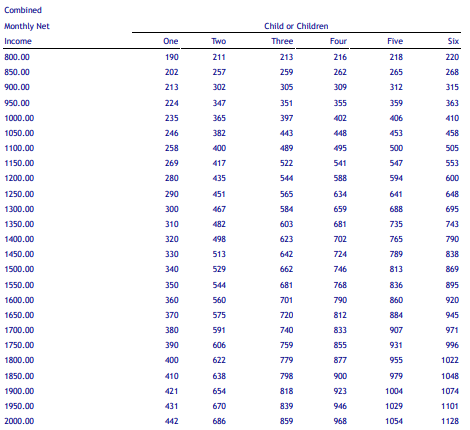
Above this message, you will see an excerpt of Florida Statute 61.30 which provides minimum child support need based on the parent’s combined net income. You can also use our 2026 Florida Child Support Calculator to estimate your child support obligations.
Part I: A Primer on Florida Child Support
The Legal Foundation: Florida Statute §61.29
Florida child support exists for one reason. Under Florida Statute §61.29 “each parent has a fundamental obligation to support his or her minor or legally dependent child.. based on the parent’s combined net income.” “The guidelines encourage fair and efficient settlement of support issues between parents and minimizes the need for litigation.”
Despite what you may have heard, the law does not treat child support as a penalty against a mom or a dad. It is simply an income-sharing model designed to ensure the child continues to have a similar lifestyle in both households after the parents separate.
Courts are required to determine each parent’s net monthly income, combine those figures, and then allocate child support responsibility proportionally. A parent who earns 60 percent of the combined household income is expected to contribute 60 percent of the child’s financial needs, adjusted for time-sharing and direct expenses. The math gets a little more convoluted if both parents have 73 or more overnights which is when you use the gross-up or the “substantial time-sharing method.”
My Spouse Doesn’t Want Child Support Why Do I Have to Pay?
The statute also makes clear that child support is the right of the child, not the parent. Custodial parents cannot waive it. Parents cannot contract it away in a private agreement unless a court reviews and approves that agreement. Usually, in order for child support to be waived, judges will require a hearing and consider a Motion for Downward Deviation of Child Support. At the end of the day, the child’s financial security is the court’s primary concern.
Key Insight
Child support is a financial balancing system. Judges do not use child support as a tool to express disapproval of a parent’s conduct. Do not walk into a courtroom and complain that it is not fair that you must pay child support. The law simply does not pay any attention to what is fair to you or the other parent.
What Courts Actually Care About
Florida judges reviewing child support are focused on three things: an accurate determination of income, an accurate accounting of child related expenses, and the number of overnights of time-sharing between the parents. Judges are not moved by claims that one parent is irresponsible with money.
The parents who suffer the most in child support proceedings are those who come to court with incomplete financial records, inconsistent income reporting, or a parenting schedule on paper that does not match what is happening in real life.
The Number 1 Misconception about Child Support in Florida
#1 Misconception: “If we agree to 50/50 timesharing, no one pays child support.” This is one of the most persistent myths in Florida family law that I have heard and seen. Equal time-sharing does not eliminate child support. It adjusts it. If one parent earns significantly more than the other, that parent will still owe support even with a perfectly even schedule. Similarly, if one parent covers all of the child’s daycare expenses, health insurance and they make less money, even with equal time-sharing, there will still be a child support payment being made by one parent to the other.
Part II: How Florida Child Support Is Calculated, Step by Step
The Governing Statute: Florida §61.30
Florida Statute §61.30 establishes the guidelines courts are required to follow in every child support calculation and proceeding. These guidelines are mandatory and they presumptively establish the amount of child support. Any deviation from the guideline amount requires written findings explaining why the deviation serves the child’s best interests.
The calculation follows a sequential process. Each step builds on the one before it. An error at Step 1 compounds through every subsequent calculation.
Step 1: Determine Gross Income
Gross income under Florida law is broadly defined. It includes ANY FORM of wages, salaries, commissions, bonuses, overtime, tips, business income, rental income, dividends, interest, Social Security benefits, disability payments, workers’ compensation, unemployment, and any other recurring source of money. Florida Statute §61.046 defines income expansively, and courts interpret that definition broadly.
This is where the first major battle occurs in most cases. Gross income disputes take three primary forms:
- Hidden Income: One parent reports a salary that does not reflect their actual earnings. This is especially common in businesses owned solely owned by one parent (where personal expenses are run through a business), cash-heavy businesses, and in situations where a parent receives significant non-cash compensation (such as a company car or housing allowance).
- Underreported Business Revenue: Self-employed parents often show a net business income that reflects aggressive deductions. Oftentimes, the Profit and Loss Statement (P&L) show a very different picture than the lifestyle and spending patterns. If something looks fishy, always look at gross receipts, lifestyle indicators, and whether claimed deductions reflect genuine business expenses or personal spending disguised as overhead.
- Bonus Games: A parent who received large bonuses in prior years may argue those were non-recurring. We have even seen parents ask their employers to defer bonuses to avoid the income showing up for purposes of calculating child support. Be on the lookout for drastic changes in compensation schedules and bonus payments.
Step 2: Arrive at Net Income
Once gross income is established, the court calculates net income by subtracting allowable deductions. These include federal, state, and local income taxes at the actual rate applicable to each parent, mandatory union dues, mandatory retirement contributions, health insurance payments for the parent and any prior children, and court-ordered child support for children from other relationships.
The net income calculation matters because the guideline formula operates on net figures, not gross. A parent earning $120,000 gross does not have $10,000 a month in net income available for child support purposes. After taxes and allowable deductions, the actual figure may be considerably lower. Courts are required to make specific, supported findings about net income.
Step 3: Combine Both Parents' Net Incomes
The court adds both parents’ monthly net incomes together to arrive at a combined net monthly income. Each parent’s individual net income is then expressed as a percentage of that combined figure. These percentages are used to allocate financial responsibility proportionally.
For example, if Parent A has a net monthly income of $4,000 and Parent B has a net monthly income of $6,000, the combined figure is $10,000. Parent A is responsible for 40 percent of the child support obligation. Parent B is responsible for 60 percent.
Step 4: Apply the Guideline Schedule
Florida’s guideline schedule found in Florida Statute §61.30 provides a chart that identifies the presumptive monthly support obligation based on combined net income and number of children. This is the starting presumptive number before any adjustments for child related expenses or time-sharing.
The presumed amount of child support referenced in the schedule increases with income up to a combined net monthly income of approximately $10,000. Above that threshold, the statute provides that additional support is at the court’s discretion based on the child’s needs and parents’ available resources.
Step 5: Add Allowable Child Related Additional Expenses
Several expenses may be added directly to the guideline amount.
- Health insurance premiums for the child (only the portion for the minor child);
- Reasonable work-related childcare expenses; and,
- Uncovered medical, dental, and prescription costs.
Each of these amounts is allocated between the parents in proportion to their respective income percentages. The parent who actually pays the expense receives a credit for that contribution. The parent who does not pay it contributes their share through the support obligation (it increases the amount of money that they need to pay of the presumptive child support amount).
Disputes over childcare costs are extremely common. Courts require competent and substantial evidence of actual current childcare expenses.
Step 6: Consider the Need for Child Support Adjustments
Florida Statute §61.30(11)(a) gives the court the ability to adjust the total minimum child support award based on a number of factors, including but not limited to: extraordinary medical, psychological, educational, or dental expenses; the independent income of the child, not to include moneys received by a child from supplemental security income; the payment of support for a parent which has been regularly paid and for which there is a demonstrated need; seasonal variations in one or both parents’ incomes or expenses; the age of the child, taking into account the greater needs of older children; the special needs, such as costs that may be associated with the disability of a child, that have traditionally been met within the family budget even though fulfilling those needs will cause the support to exceed the presumptive amount established by the guidelines; and the total available assets of the obligee, obligor, and the child.
In addition, Florida Statute §61.30(11)(b) provides for an adjustment to the support if both parents have at least 20 percent of the overnights in a calendar year, which works out to roughly 73 overnights.
Once a parent reaches that threshold, the court applies a formula that reduces their support obligation to reflect the direct expenses they bear when the child is in their home. The adjustment is not dollar-for-dollar. It is a proportional reduction that accounts for the fact that both parents are now spending money directly on the child during their respective parenting time.
The time-sharing adjustment is one of the most litigated issues in Florida child support cases. Disputes arise over whether the parenting schedule is actually being exercised, whether overnights are being counted correctly, and whether a parent is inflating claimed overnights to reduce their support obligation.
Strategic Takeaway
The difference between 70 overnights and 73 overnights per year can shift the support calculation meaningfully. Parents who are close to the 20 percent threshold should document every overnight with calendars, school records, and other verifiable evidence.
Step 7: Final Number and Possible Deviation
After all adjustments, the court arrives at a presumptive guideline amount. That number becomes the order unless one party presents compelling evidence that a deviation is warranted.
Deviations of more than five percent in either direction require written judicial findings explaining why the deviation serves the child’s best interests. Deviations within five percent are easier to obtain but still require some factual basis. Courts cannot simply pull a number out of thin air.
Part III: Additional Considerations when Calculating Child Support in Florida
Imputed Income: Make Believe Money
One of the most powerful tools in Florida child support litigation is the court’s authority to impute income to a parent. Imputation means the court assigns an income figure higher than what the parent actually earns or claims to earn, based on the parent’s demonstrated ability and the available job market.
Florida courts have consistently held that a parent cannot voluntarily reduce their income to avoid child support obligations. As an example, if a parent who previously earned $90,000 per year quits their job two weeks before a child support hearing and claims to earn only $15 per hour, the court will not simply accept that figure.
To impute income, courts look at two elements: the parent’s ability to earn more, meaning their education, work history, skills, and prior earnings; and the availability of employment in the relevant market. Both elements must be supported by evidence.
Case Law Note
The Florida Supreme Court and other district courts have suggested that a presumption
arises from a spouse’s historical earnings that supports a finding the spouse can continue to earn the same amount, absent evidence to the contrary.” Mata v. Mata, 185 So.3d 1271, 1272-73 (Fla. 3rd DCA, 2016); see also Garfield v. Garfield, 58 So.2d 166, 167-68 (Fla. 1952).
Ready to Understand Your Actual Number?
Child support in Florida is formula-driven. If you prefer not to work through the calculations yourself, we offer a simple, free Florida Child Support Calculator designed to help you estimate your potential child support obligation using the same general framework applied by courts under Florida Statute §61.30.
The calculator walks you through key inputs such as income, time-sharing, and child-related expenses to provide a practical starting point for understanding your numbers. It is particularly useful if you are preparing for mediation, evaluating a proposed agreement, or simply trying to get a clearer picture of what child support may look like in your situation.
Importantly, we do not store, track, or retain any of the information you enter. This tool is completely free and provided as a public resource for your convenience. Please keep in mind that the calculator is for educational purposes only and does not constitute legal advice, and the accuracy of any estimate depends entirely on the accuracy of the information entered. Moreover, using the calculator does not create an attorney-client relationship with TK Law, P.A. or its attorneys.
If you are facing a child support proceeding in Central Florida, the most important thing you can do right now is get educated.
Our attorneys work with parents throughout Orange, Seminole, Volusia, Flagler, Osceola, and Lake Counties on complex child support matters involving self-employment income, time-sharing disputes, modification proceedings, and enforcement.
Schedule a Consultation Today
Call our office or submit an inquiry online. We will review the specific facts of your situation and help you understand what the numbers should actually look like, before you make a costly mistake based on an incomplete picture.
This article is intended for general informational purposes only and does not constitute legal advice. Florida child support matters involve complex, fact-specific analysis. Consult a licensed Florida family law attorney regarding your individual circumstances.